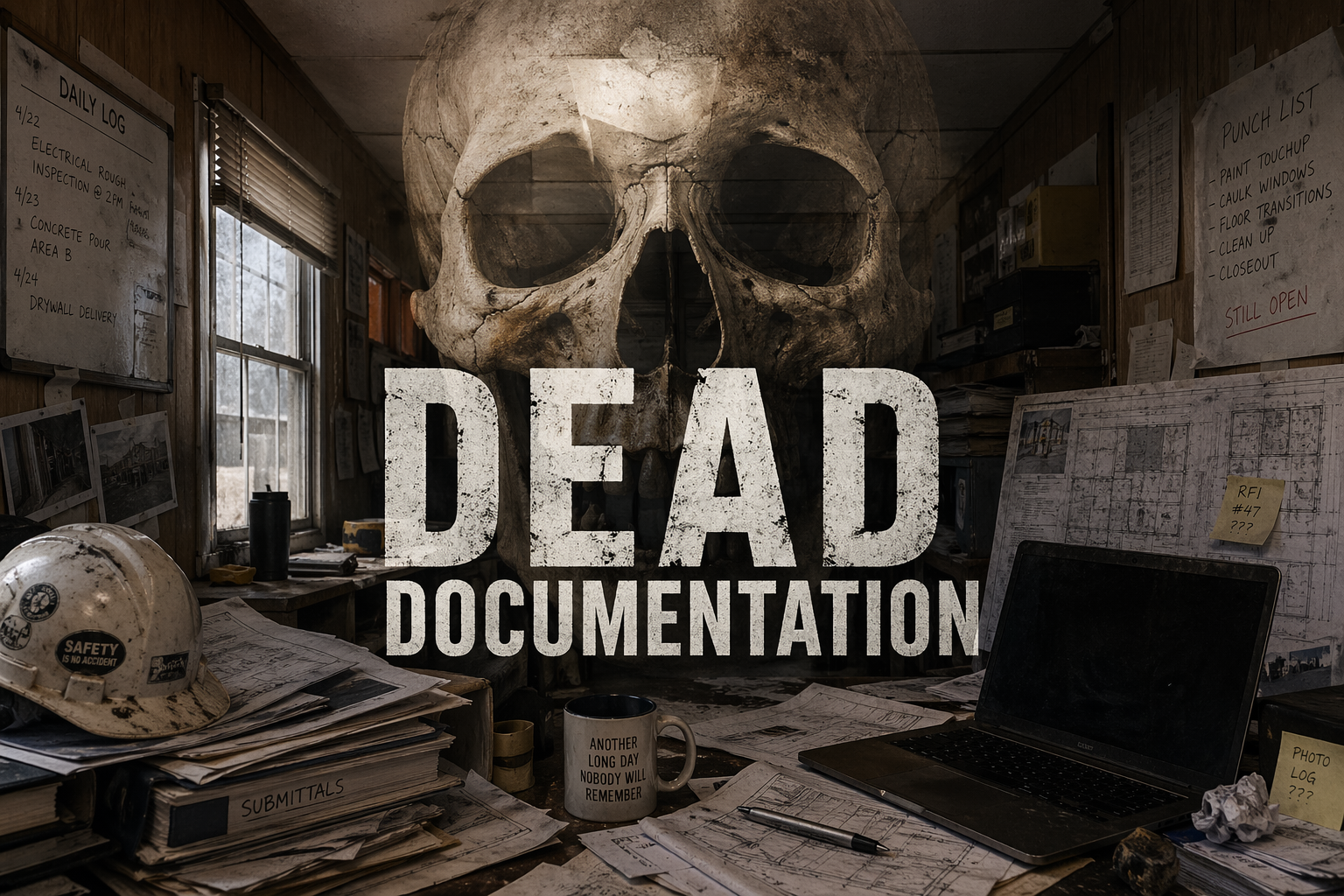
The $177 Billion Problem: How Miscommunication is Bleeding Construction Profits Dry
Miscommunication costs the U.S. construction industry an estimated $177 billion every year — driven by rework, lost productivity, and decisions that vanish into thin air the moment someone hangs up the phone. Over 48% of all rework is caused by poor communication and bad project data, not mistakes in the field. The fix isn't more meetings or more emails — it's capturing what's actually said on the jobsite, automatically.
Alena Tuttle
Miscommunication costs the U.S. construction industry an estimated $177 billion every year — driven by rework, lost productivity, and decisions that vanish into thin air the moment someone hangs up the phone. Over 48% of all rework is caused by poor communication and bad project data, not mistakes in the field. The fix isn't more meetings or more emails — it's capturing what's actually said on the jobsite, automatically.
If you're in construction, you know how much of building is just coordination. You're calling Tony back because he swears you never told him about the panel change. You're scrolling through 47 texts trying to find who approved the pour schedule. You're rewriting a daily log at 9pm from memory because — surprise — nobody documented the three most important calls of the day.
And all of that? It's not just annoying. It's expensive. Like, obscenely expensive.
$177 Billion. With a B.
In 2018, PlanGrid and FMI surveyed nearly 600 construction leaders and found that the U.S. construction industry wastes $177.5 billion per year on non-productive activities. Not on materials. Not on labor doing actual work. On people spending their time fixing mistakes, hunting down information, and resolving conflicts that shouldn't exist in the first place.
$177 billion in wasted labor — every single year.
For a mid-sized construction company, that translates to roughly $2 billion per year in avoidable costs. And for the superintendent on the ground? It means over 14 hours per week — basically two full working days — spent on stuff that has nothing to do with actually building.
It's Not the Workers. It's the Information.
Rework isn't happening because your crews don't know how to do their jobs. The same PlanGrid/FMI study found that 48% of all rework on U.S. jobsites is caused by miscommunication and poor project data. Globally, that number jumps to 52%.
Here's the split:
- 26% of rework comes from straight-up poor communication between team members - 22% is from bad or inaccessible project information — wrong drawings, outdated specs, data that lives in somebody's head instead of on a shared platform
The Construction Industry Institute (CII) estimates rework eats up 5-10% of total project value on average. On a $10 million project, that's $500K - $1M just... gone. Because somebody said something on a phone call and nobody wrote it down.
That's actually the conservative number. Navigant's research suggests the real number could be closer to 9% once you factor in the rework that never gets officially "reported" — the stuff teams just quietly fix and eat the cost.
Where All That Money Actually Goes
So what does $177 billion in waste actually look like on a Tuesday afternoon? According to the FMI research, construction workers spend an average of:
- 5.1 hours per week just looking for project data — hunting down revised plans, tracking down the right drawing version, finding the budget cut sheet someone emailed three weeks ago - 4.7 hours per week on conflict resolution — which is a fancy way of saying "arguing about what somebody said" - 3.5 hours per week dealing with mistakes and rework — tearing out what was built and doing it again
That's 13+ hours a week. Per person. That's not a workflow problem. That's a business model problem.
Jay Snyder, FMI's technology practice lead, put it bluntly: "Poor communication among team members, and incorrect or inaccessible information that workers need to do their job is costing the construction industry tens of billions of dollars annually."
The Real Villain: The Phone Call That Disappears
Phone calls, site conversations, crew check-ins....That's how the real work gets coordinated.
But what happens after that call ends?
The decision evaporates. The commitment becomes a maybe. The task that was "definitely happening by Thursday" becomes a finger-pointing match by the following Monday.
Less than 10% of phone-based decisions ever get formally documented. Think about that — 90% of the critical conversations happening on your project have zero paper trail. And then everyone acts shocked when there's a dispute.
The Fix Isn't More Meetings
I know what you're thinking: "Okay, so we need better communication. Got it. Let's schedule a meeting."
Please, no more meetings.
The problem isn't that people aren't communicating. They're communicating constantly — on the phone, on the jobsite, in the trailer. The problem is that none of it gets captured.
The most effective construction teams in 2026 aren't scheduling more check-ins or buying more binders. They're using voice-first documentation — tools that capture the conversations that are already happening and turn them into structured project data automatically.
No typing. No forms. No "I'll write it up when I get back to my truck."
At Hardline, this is exactly what we built. You make a call, we transcribe it in real time, extract the tasks and decisions, and sync everything to your project management tool. Same phone you already carry. Zero learning curve. Your call with the electrician at 7am becomes a documented summary with tasks by 7:02am.
Because the information was never the problem. Losing it was.
What This Actually Means for Your Bottom Line
Run the numbers:
- A superintendent's time is worth roughly $75-100/hour when you factor in salary, benefits, and overhead - If they're wasting 14 hours/week on non-productive activities, that's $1,050-$1,400 per week of wasted productivity — per person - Over a year, that's $54,600-$72,800 per superintendent
Now multiply that across your team. Three supers? That's $160K-$218K per year in lost productivity. And that's before you count the cost of a single rework event or dispute.
A study analyzing 346 contractor projects found that rework led to a 28% reduction in average annual profit. Not revenue — profit. The money you're supposed to take home.
One prevented dispute — one conversation that's properly documented instead of lost — can easily save $50,000-$500,000. That alone pays for voice documentation tools for years.
Stop Bleeding Money on Things You Already Said
Look, I get it. Construction has always been messy. There's always going to be chaos on the jobsite. But there's a difference between the chaos of building something complex and the chaos of losing information that already existed — in someone's pocket, on someone's phone, in someone's memory.
$177 billion per year isn't a communication problem. It's a capture problem.
The fix is actually pretty obvious: stop letting your most important conversations disappear.
Hardline turns every construction phone call into documented, organized project data — automatically. No typing, no forms, no learning curve. Book a 20-minute demo and see how it works.
Sources
- PlanGrid & FMI, "Construction Disconnected" Report (2018) — Survey of 600 construction leaders on time waste and miscommunication costs - Construction Dive coverage of the $177B finding - For Construction Pros: Poor Communication Costs $177B Annually - PlanRadar: Cost of Rework in Construction (2025) — CII and industry rework benchmarks - Visibuild: The True Cost of Rework in Construction — Analysis of rework impact on contractor profitability - InspectMind: Construction Rework Costs 5-15% of Project Value — Navigant and broader industry research - Full PlanGrid/FMI Report PDF
Ready to capture every conversation?
Hardline turns your calls and site conversations into daily logs, RFIs, tasks, and more — automatically.
Book a Demo