Why Dead Documentation Kills Your Construction Tech Stack
Every tool in the trailer is only as good as the field data you feed it at 5pm.
Alena Tuttle
On most commercial jobsites in the country, the three-week lookahead is a work of fiction. Not because the scheduling software is bad — it's actually gotten pretty good. It's fiction because scheduling, like every other critical process on a job, depends on accurate information from the field. And that information almost never exists.
A superintendent walks the site at 10am, heads back to the trailer at noon, and updates the schedule from memory at 5pm. By the time it hits the system, it's already wrong. The lookahead goes out Tuesday morning based on Monday's best guess about Friday's conditions. Subs plan around it. Materials get sequenced to it. By Wednesday, half of it has already shifted.
The real dataset lives on site — for about eight hours
At 10am, that superintendent has the most accurate picture of the jobsite that exists anywhere. What's poured, what's behind, which crews are short, where the conflicts are. By 5pm it's a half-remembered summary typed into three different platforms.
The richest dataset on any construction project lives in the heads of the people walking the site every morning. By evening, it gets compressed into something barely usable and entered into a system that was built to expect better. That compression — from real-time field knowledge to stale data entry — is what produces dead documentation. And almost every platform in the tech stack is built on top of it.
Labor productivity in U.S. construction has declined roughly 30% since 1970. The broader economy more than doubled its output per worker in the same period. Manufacturing tripled. The standard explanation is that construction has been slow to adopt technology — but that hasn't been true for a while. AI and machine learning adoption grew to 37% in 2025, up from 26% two years earlier.
The industry has project management platforms, BIM tools, coordination software, safety apps, daily reporting apps, punch list apps. There is no shortage of software. And yet every new tool added to the stack has made the actual problem worse, not better — because each one is another system a field team has to manually feed at the end of the day.
What dead documentation actually is
Field teams witness and create the most detailed, accurate project information that exists. They see exactly what's installed, what's blocked, what shifted overnight, which areas are ready for the next trade. A foreman standing on the third floor at 9am knows more about the real status of that floor than anything in any system.
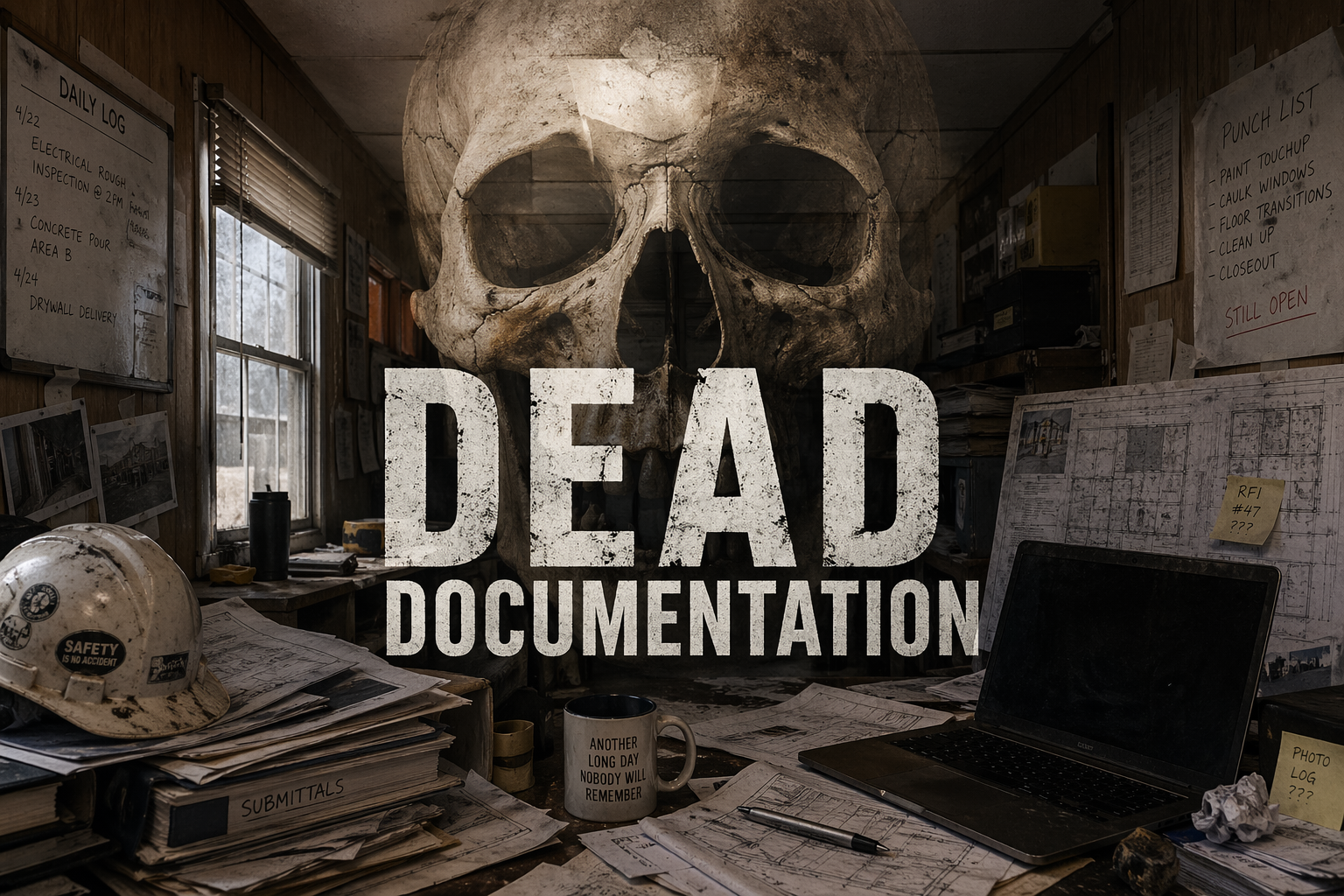
By the time any of it gets entered into a platform — hours later, from memory, stripped of detail — it becomes dead documentation. The daily log written at 6pm from memory. The progress photo uploaded three days late. The percent-complete number communicated on a one-off phone call to the PM.
According to FMI, 30% of construction professionals say more than half of their project data provides no valuable insights. PlanRadar's 2025 research puts a finer point on it: 48% of all rework in U.S. construction traces back to poor data and miscommunication. That's over $31 billion per year. Not because the information didn't exist — but because nothing captured it while it was still fresh.
And the industry's solution has been to ask field teams to do more data entry. The workforce is short over 500,000 people. The ones still showing up are running ten-hour days on understaffed crews. The response has been to hand them another login and another platform to update at the end of the shift. Superintendents didn't get into construction to spend their evenings doing paperwork.
Dead documentation wearing five masks
Go back to that three-week lookahead. The schedule isn't wrong because the scheduling tool is wrong. It's wrong because the field data feeding it is 12 to 72 hours old. Lean practitioners built pull planning and lookaheads specifically to create reliable short-term commitments. Dead documentation undermines them at the source. The information those frameworks need gets generated every morning on every jobsite. It just doesn't make it into the system while it's still true.
Coordination breaks the same way. Trade coordination requires knowing what's complete, what's ready, and what's blocked. Every superintendent on the job knows this by mid-morning. But without a way to capture it in real time, coordination meetings run on "I think" and "last I checked." Across 15 trades on a busy jobsite, that's a room full of people making decisions on information that's somewhere between half a day and three days old. The coordination platform works fine. The information inside it doesn't.
RFIs compound it. Large projects generate 800 to 1,400 or more, each adding an average of 10 to 14 days of delay. When submissions are missing context, wrong references, or supporting photos — because the field reality was never captured when it was fresh — they trigger multiple rounds of clarification. The delays stack.
Material delivery follows the same pattern. Sequencing depends on installation readiness. When the field picture is hours old, materials show up early with nowhere to store them, or late with crews standing idle.
Billing closes the loop. Pay apps tied to percent-complete are only as accurate as the documentation behind them. The result: disputed invoices, slow payments, and cash flow problems that ripple through every sub on the project.
What needs to change
Construction doesn't need more software. It needs software that captures field knowledge while it's still accurate — in real time, in context, at the point of work — and routes it automatically into the systems that depend on it. Live documentation instead of dead documentation.
Real-time asset tracking alone — just knowing where equipment and materials are — can boost jobsite productivity by up to 20%. Companies with consistent real-time QA/QC processes keep rework costs under 5% of project budget at nearly double the rate of those without. That's from capturing a small fraction of what field teams already know every morning.
The technology to do this exists. But the industry keeps buying the next tool in the stack instead of fixing the first one. A better scheduling platform doesn't help if the progress data feeding it is twelve hours old. A smarter coordination tool doesn't help if the field picture it's coordinating around is already wrong.
None of it works until the information coming off the jobsite is accurate, current, and automatic. Start there, and every tool in the trailer gets better. Skip it, and the software budget keeps climbing while productivity stays flat.
Ready to capture every conversation?
Hardline turns your calls and site conversations into daily logs, RFIs, tasks, and more — automatically.
Book a Demo