Construction Just Got a $500M AI Upgrade. Your Superintendent Is Still Walking the Job With a Notepad.
Trimble's acquisition of Document Crunch signals where the industry thinks the communication problem lives. It doesn't live in the contract — it lives in the 3pm gap between what your superintendent knows and what exists in any project record.
Alena Tuttle
Last week, Trimble announced it's buying Document Crunch — an AI platform that reads construction contracts and flags risk. Good technology. Real problem. The deal is worth noting, not because of what it does, but because of what it reveals about where the construction industry thinks its communication problem lives.
It doesn't live in the contract.
The contract was signed months ago. The owners and executives who negotiated it aren't on the job site. The people who are on the job site — the superintendents, the foremen, the project engineers — don't spend their days reading contract language. They spend their days managing the gap between what the contract says should happen and what's actually happening on the ground, in real time, with the crews they have and the weather they got.
That gap — the 3pm gap between what your superintendent knows and what exists in any project record — is where $31.3 billion in construction communication failures starts every single year. Trimble's AI doesn't touch it. Neither does anyone else's.
The Industry Is Building AI in the Wrong Direction
Let's look at where construction tech investment is actually going.
Trimble acquires Document Crunch: AI for contract risk analysis. Procore adds AI to project management dashboards. Autodesk builds AI into BIM coordination. Dozens of startups raise funding for AI-powered scheduling, estimating, and bid management.
All of it is office-layer technology. Built for project managers, executives, and risk teams who are paid to sit at desks and analyze information. Built assuming that the information they need is already somewhere in a system, waiting to be processed.
That assumption is the problem.
A new industry study found that 41% of global construction teams say poor coordination is a leading cause of rework on their projects. Poor communication costs the construction industry $31.3 billion in labor and materials every year. And despite the AI investment boom, 92% of construction projects still run over budget by 6% or more.
The AI is getting smarter. The coordination problem isn't getting better. That should tell you something about where the problem actually lives.
Where the Money Goes vs. Where the Problem Is
The people who buy and implement construction software are project managers and executives. They're in the office. They have computers. They're accustomed to software workflows. When they get pitched AI tools, the demos make sense to them because the demos show dashboards, analytics, and interfaces that look like the tools they already use.
The people who generate the most operationally critical information on a construction project don't work in the office. They work outside, in steel-toed boots, managing eight trades at once, making dozens of decisions before lunch. When they get pitched software, the demos usually involve pulling out a phone, logging into an app, navigating to the right project, finding the right form, filling it out correctly, and submitting it.
That's not a workflow. On an active jobsite, that's a four-minute interruption. At ten interruptions a day — a conservative estimate of the observations a working superintendent makes — that's forty minutes of documentation work that competes directly with running the job.
What actually happens is this: the observations go unrecorded. The verbal instructions disappear. The moment when the super noticed the substrate issue, mentioned it to the foreman, and got a verbal confirmation that it would be addressed — that moment never enters any system. It lives in the super's memory until the end of the day, when the daily log gets filled out as a summary, stripped of specificity, filtered through fatigue.
The field intelligence that should be driving your project record is dying in the gap between observation and documentation. The AI tools the industry is excited about start after that gap. They process what made it into the system. They have no visibility into what didn't.
What the 3pm Gap Actually Costs
The numbers on construction miscommunication are well-documented. What's less discussed is the mechanism.
Rework — fixing work that was done wrong — consumes 5–10% of total project costs on a typical commercial build. Up to 52% of that rework traces back to miscommunication and coordination failures. On a $20M project, that's $1M to $2M in work that has to be done twice, at minimum. Often more.
But where specifically does that miscommunication happen? Not in the contract. The miscommunication happens when the super on Section C notices the framing is out of plumb on a Tuesday afternoon, mentions it to the framing lead, gets told it'll be addressed before inspection, and then — because nothing was documented — the issue slips through. The framing lead's crew moves on. The inspection happens. The problem makes it into the structure.
Or the miscommunication happens when a material delivery arrives and the site supervisor notices the concrete batch looks off, makes a judgment call to accept it, and doesn't document that decision. Six months later, when the slab shows stress cracks, nobody can reconstruct what happened on that delivery.
Or it happens in the morning walk-through, when the super mentally flags three items and communicates them verbally to three different subs. None of those conversations happen in any system. Two of the three items get addressed. One doesn't. The one that doesn't becomes a defect claim.
These aren't documentation failures caused by bad intent. They're documentation failures caused by friction. The tools available for capturing field observations were not designed for field workers.
Why Field Workers Don't Use Construction Software (and Never Will)
The superintendents who have the most field experience and the most operationally critical judgment are the least likely to document in real time. Not because they're resistant to technology. Because they're running a job.
A superintendent managing a $15M commercial build is managing labor, materials, schedule, safety, subcontractors, owner communications, and RFIs simultaneously. They're making rapid decisions in a dynamic environment. The mental model that drives their effectiveness is not compatible with the mental model required to navigate a software interface.
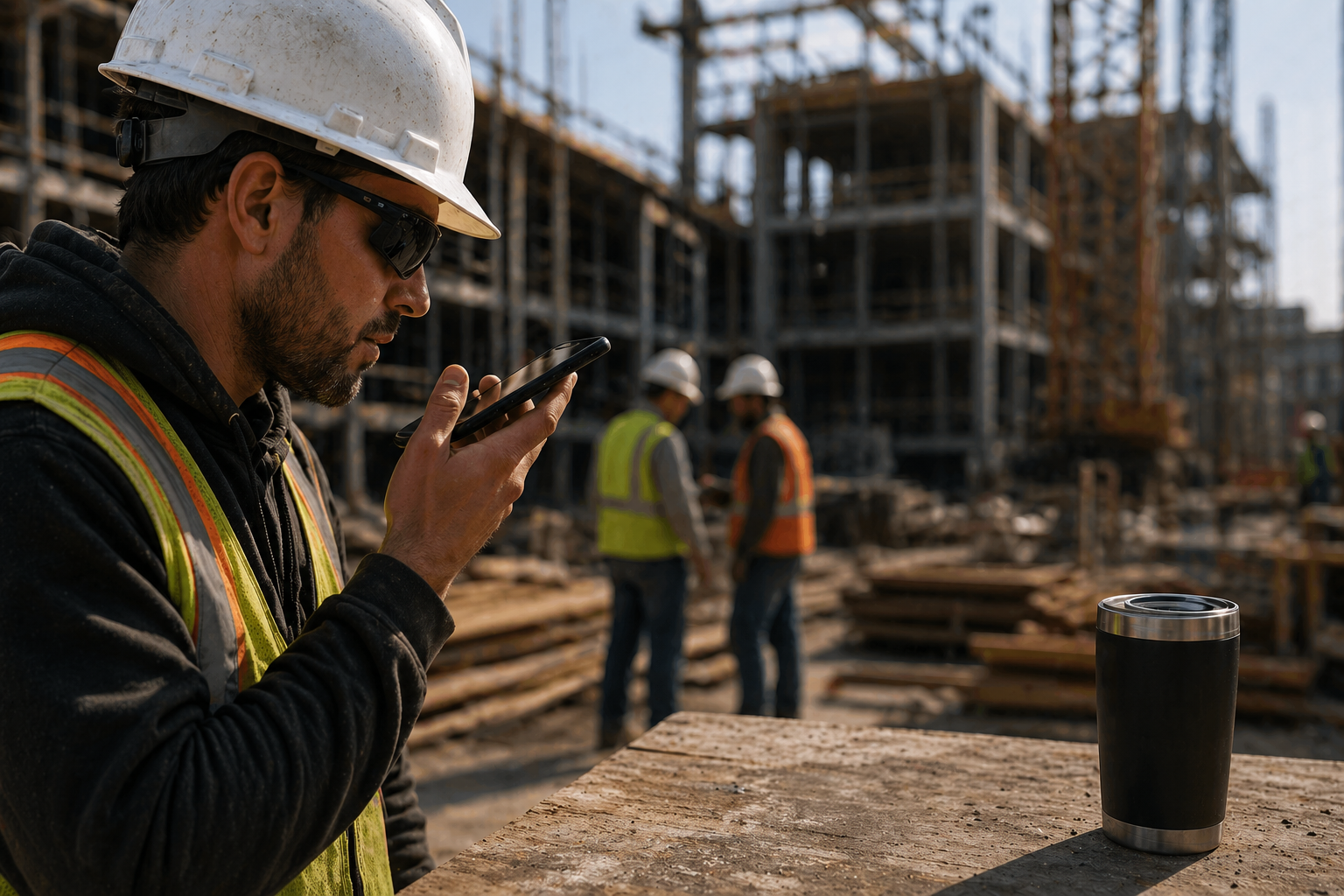
They walk the job and they talk. They narrate what they see to the people around them. "That's going to need to come down." "Tell the electricals we need two more rough-in boxes on this elevation." "Flag that pipe penetration before the inspector gets here." This is how jobsite communication actually works — verbal, real-time, contextual.
Every documentation tool built to capture field observations requires them to stop doing that and start doing something else. Open the phone. Log in. Find the project. Find the section. Type or select. Submit. Then get back to the job.
That friction, across a thousand small observations per project, produces the documentation gap that no office-layer AI can address — because by the time information reaches those systems, the most important field intelligence has already been lost.
What Voice-First Field Documentation Actually Means
There's a version of field documentation that meets supers where they are.
The superintendent who's already narrating the site walk shouldn't have to do anything differently to produce a field record. "Noting the parapet membrane on the north elevation — termination detail looks thin, flagging for sub QC review before the city inspection" — that observation, spoken in the natural flow of the site walk, should become a timestamped, project-tagged field record. Not a note to follow up on later. The record, created at the moment the observation happens.
Voice-first documentation isn't a new concept. What makes it viable now is the combination of accurate transcription, automatic structure, and smart project context — a system that knows which project you're on, routes the observation to the right record, and makes it searchable without requiring the field worker to categorize anything manually.
When documentation is as fast as talking, supers will document. Not because the software is better. Because the act of documenting is no longer in competition with the act of running the job.
That's what closes the 3pm gap. And closing the 3pm gap is what prevents the rework, the defect claims, and the coordination failures that no amount of contract AI can fix.
What to Do About It
- Audit the dark record on your current projects. Pick one active project. Ask your super how many quality observations they've made in the last two weeks. Then count how many of them are in the formal project record. The gap between those two numbers is your exposure.
- Stop solving the documentation problem with training. Field workers don't document because the tools require them to stop working. More training doesn't fix friction — it just creates frustration. The right tool changes the behavior by eliminating the behavior change required.
- Be skeptical of AI tools that only work after the call or meeting is over. Most construction AI processes information that already made it into a system. If the tool can't capture what happens in the field in real time, it's managing the paper record — not the actual job.
- Treat field observations as legal and financial documents. The foreman who noticed the nailer pattern before the inspector came was building your defense. If that observation doesn't exist in a dated, project-tagged record, it might as well have never happened.
The construction AI boom is real. The investment is justified. But a market that's consolidating around contract-layer intelligence while the field coordination crisis continues unaddressed isn't solving the $31 billion problem — it's solving the $300 million problem and leaving the rest on the table.
The industry just got a major AI upgrade. It's pointed at the wrong end of the problem.
Hardline is built for the other end — where the actual coordination failures start. Voice-first field documentation that captures what your team sees, says, and decides on the job, in real time, without stopping the work.
Ready to capture every conversation?
Hardline turns your calls and site conversations into daily logs, RFIs, tasks, and more — automatically.
Book a Demo