Will AI Replace Construction Workers? What Field Leaders Need to Know in 2026
87% of contractors believe AI will have a meaningful effect on their industry. But the conversation about what that actually means for the people running jobsites has been dominated by hype and fear. Here's what's really happening — and what it means for your career.
Alena Tuttle
87% of contractors believe AI will have a meaningful effect on their industry. But the conversation about what that actually means for the people running jobsites has been dominated by hype and fear. Here's what's really happening — and what it means for your career.
Will AI Replace Construction Workers? The Two Narratives — Both Wrong
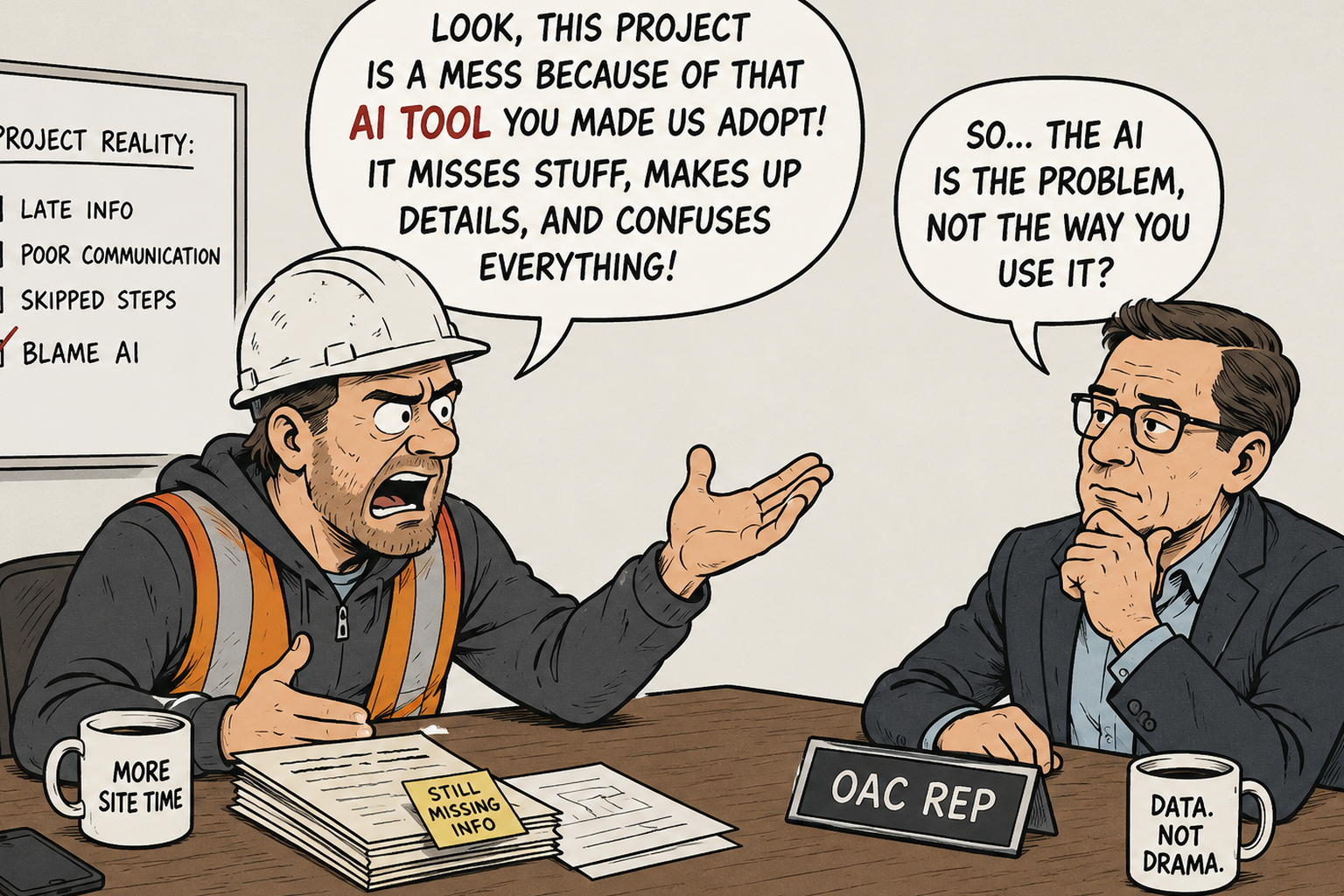
If you've been paying attention to the AI conversation in construction, you've probably noticed two camps. Camp one says AI is going to automate everything and everyone should be worried. Camp two says construction is "too complex" for AI and nothing will change. Both are wrong.
The reality is somewhere in the middle — and if you're a superintendent, head of field ops, or general superintendent, where you land depends entirely on how you respond in the next 12–18 months.
Why Superintendents Fear AI Replacement — And Why That Fear Is Misdirected
Let's acknowledge the elephant in the room. When 87% of contractors say AI will meaningfully impact the industry, that gets people's attention. And when you see AI tools that can generate daily reports, analyze schedules, predict delays, and draft RFIs, it's natural to wonder: where does that leave me?
Here's the honest answer: AI is not coming for superintendents. It's coming for the tasks that keep superintendents from doing what they're actually good at.
There's a meaningful difference between those two things.
A superintendent's real value isn't writing daily reports, typing up call summaries, or manually tracking which sub said what on Tuesday. Their real value is judgment. Walking a site and knowing something's off before the inspector flags it. Managing 15 personalities across 6 trades who all think their work should happen first. Making the call to shut down a pour when the forecast changes. Reading a room during an OAC meeting and knowing when to push back and when to let it go.
No AI is doing any of that. Not in 2026. Not for a long time.
What AI Actually Does Well in Construction (Right Now)
In 2026, AI in commercial construction is good at a specific set of things. It's worth being precise about what those are:
Documentation. AI can transcribe phone calls, generate meeting summaries, and draft daily reports from real-time field data. Tools like Hardline capture conversations as they happen so superintendents aren't reconstructing the day from memory at 5 PM. This is the single biggest time-saver most field leaders will encounter — not a threat, but 1–2 hours back every day.
Pattern recognition. AI can analyze schedule data and flag risks before they escalate — a sub trending behind on rough-in, a material delivery that's going to conflict with a concrete pour. It doesn't replace the super's instinct. It gives them data to back it up.
Information retrieval. Instead of scrolling through 200 emails to find the drawing revision or the RFI response from three weeks ago, AI can surface the right document in seconds. The search-and-retrieve problem that costs field teams 5+ hours per week is shrinking fast.
Administrative automation. Generating reports, syncing data between PM tools, sending follow-up summaries after calls — the paperwork layer that's been growing for decades is finally getting compressed.
Notice what's not on that list: managing crews, negotiating with subs, reading a jobsite, making safety calls, building relationships with inspectors, or any of the thousand judgment-based decisions a superintendent makes every week.
The Real Career Risk: Supers Who Use AI Will Outcompete Those Who Don't
Here's the career insight most people are missing. AI isn't going to replace superintendents. But a superintendent who uses AI effectively is going to outperform one who doesn't.
Think about it from the GC's perspective. You have two supers with similar experience:
Super A spends 14 hours a week on non-productive activities — chasing documents, writing reports from memory, arguing about what was said on calls because nothing was documented. Their projects run fine, but there's always friction, always disputes, always the feeling that information is slipping through the cracks.
Super B uses AI to capture every call, auto-generate daily reports, and surface schedule risks before they become problems. They spend those 14 hours on actual project management — crew coordination, quality walks, proactive sub management. Their documentation is airtight. Their projects run cleaner. They win disputes because they have timestamped records of every decision.
Which super gets the next project? Which one gets promoted to general superintendent? That's the real competitive dynamic. It's not human vs. AI. It's human-with-AI vs. human-without-AI. And the gap is widening fast.
What the Data Actually Says
Let's get specific. According to PlanGrid and FMI, construction professionals lose 35% of their time — over 14 hours per week — to non-productive activities like hunting for information, resolving disputes, and dealing with rework caused by miscommunication.
At a fully loaded superintendent cost of $75–100/hour, that's $54,600–$72,800 per person per year in lost productivity. Three supers on your team? That's $160K–$218K per year that could be going toward actual project management.
The supers who adopt AI tools recover a meaningful chunk of that time. Early adopters report saving 3+ hours per week just on documentation alone — and the downstream effects on dispute prevention and rework reduction multiply from there.
Meanwhile, 57% of contractors cite accuracy and reliability as their top AI concern, and 54% worry about data security. These are legitimate concerns. The answer isn't to avoid AI — it's to choose tools that address those concerns head-on with verifiable records, timestamped transcripts, and clear data policies.
What This Means for VPs of Ops and General Superintendents
If you're leading field operations across multiple projects, the AI question isn't just personal — it's strategic. Here's what you should be thinking about:
Standardization at scale. AI makes it possible to enforce consistent documentation and reporting standards across every project without being physically present on every jobsite. That's the promise that's hardest to deliver with manual processes.
Talent multiplication. The labor shortage isn't going away. AI doesn't replace field leaders — it makes each one more effective. A super with AI tools can manage more complexity, document more thoroughly, and communicate more efficiently. That matters when you can't find enough qualified people.
Risk reduction. Better documentation means fewer disputes, fewer claims, and better outcomes when disputes do happen. When every phone call is transcribed and every verbal approval is timestamped, the he-said-she-said that costs the industry billions per year starts to disappear.
Competitive positioning. Project owners and GCs are starting to ask about technology adoption during prequalification. The firms that can demonstrate AI-powered field operations will have an edge in winning work — especially on complex commercial projects where documentation quality directly impacts risk.
The 2026 Playbook for Field Leaders
So what should you actually do? Here's the practical version:
Stop avoiding it. The construction professionals who will struggle most are the ones who refuse to engage with AI at all. You don't have to become a tech expert. You just have to be willing to try tools that make your existing workflow better.
Start with documentation. If you're going to adopt one AI tool, make it something that captures your phone calls and auto-generates field documentation. This is the lowest-friction, highest-impact place to start. You're already making the calls. The AI just captures what comes out of them.
Protect your judgment advantage. The things that make you valuable — reading a site, managing people, making real-time decisions — are the things AI can't do. Double down on those. Use AI to eliminate the busywork so you have more time for the work that actually requires a superintendent.
Get comfortable with the tools your competitors are using. If you're not using AI-powered documentation and your competitors are, you're not just less efficient — you're more exposed in disputes and less competitive in project pursuits.
At Hardline, this is the bet we've made. Not that AI replaces field leaders, but that it amplifies them. You make your normal calls, have your normal conversations — Hardline captures everything in real time, pulls out the decisions and tasks, and syncs it to your PM tool. The superintendent stays in the field doing what they do best. The AI handles the paperwork.
In Summary
AI is not going to replace construction workers. The job requires too much human judgment, relationship management, and real-time decision-making for that to happen anytime in the foreseeable future.
But AI is going to change what the job looks like. The superintendents who thrive in 2026 and beyond will be the ones who let AI handle documentation, information retrieval, and administrative tasks — freeing themselves up to focus on the high-value work that actually requires a human on a jobsite.
The question isn't whether AI will affect your career. It already is. The question is whether you'll be the super with AI in your corner or the one still writing daily reports from memory at 5 PM.
If you want to see how AI-powered field documentation works in practice, book a 20-minute demo with Hardline. We'll show you exactly what it looks like when your phone calls write your daily reports for you.
Frequently Asked Questions
Will AI replace construction superintendents? No. AI in 2026 handles documentation, pattern recognition, and administrative tasks — not the judgment calls, crew management, and relationship-building that define a superintendent's role. AI augments field leaders; it doesn't replace them.
What construction tasks can AI actually do right now? AI currently excels at transcribing phone calls and meetings, generating daily reports from real-time data, flagging schedule risks through pattern recognition, retrieving project documents instantly, and automating administrative workflows like syncing data between PM tools.
How do I get started with AI as a construction superintendent? Start with AI-powered documentation — tools that capture your phone calls and auto-generate field reports. This is the lowest-friction entry point because it works within your existing workflow (you're already making calls) and delivers the highest immediate time savings.
Is AI in construction reliable enough to trust? Reliability concerns are valid — 57% of contractors share them. The key is choosing AI tools that produce verifiable, timestamped records rather than generating content from scratch. Tools that transcribe actual conversations and extract real decisions are fundamentally different from generic AI chatbots.
What's the ROI of AI for a construction superintendent? At a fully loaded cost of $75–100/hour, a superintendent who saves even 3 hours per week through AI-powered documentation recovers $11,700–$15,600 per year. Across a team of three superintendents, that's $35K–$47K annually — before accounting for reduced disputes and rework.
Ready to capture every conversation?
Hardline turns your calls and site conversations into daily logs, RFIs, tasks, and more — automatically.
Book a Demo