Bad AI Makes Bad Project Management Worse
A construction buyer's guide for general contractors and subs deploying AI in 2026.
Alena Tuttle
If you are a general contractor or sub buying AI for your construction business right now, or looking to deploy AI on the field, you should read this.
Quickbase just released their 2026 construction productivity report. There are two stats in it that every business owner has to understand before deciding what to buy and who on the team to deploy it with first.
- 92% of construction respondents are curious about AI tools.
- 10% are extremely confident in the accuracy of their key project information.
What does this mean? It means two things.
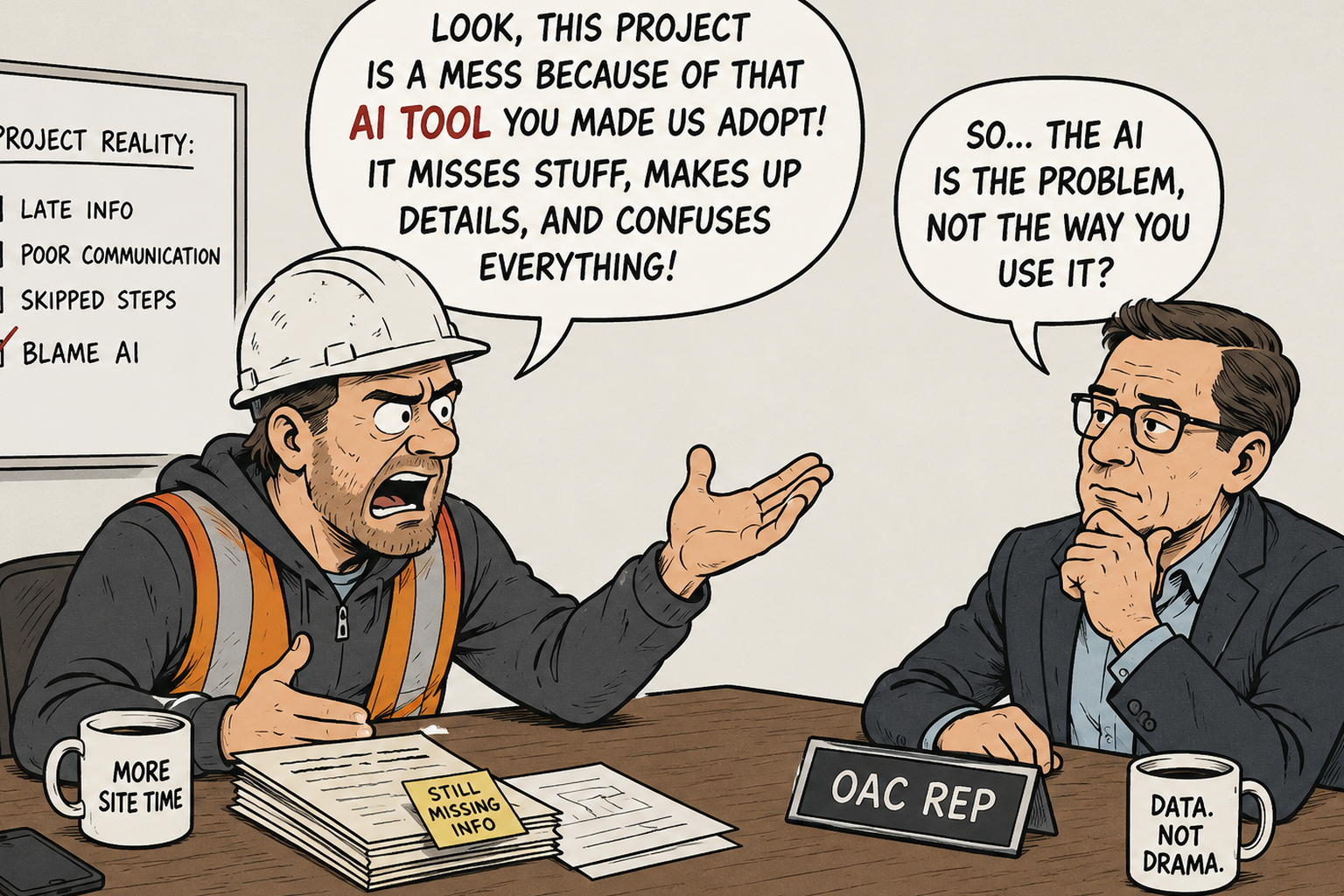
- AI makes bad project management worse.
- Bad AI makes good project management worse.
If your project management is broken, AI is going to make the broken parts more confident. If your project management is solid, the wrong AI tool can still wreck it. Both are happening right now in commercial and residential construction, and the difference between buying well and buying badly is knowing which one you are walking into.
AI makes bad project management worse
Most AI tools do not invent information. They read it. Every AI summary, every AI-generated daily log, every chatbot answer in your construction stack is based on a source of data that already exists somewhere in your systems. The AI is rewording what it finds.
So the most important question to ask any AI vendor is: where is the AI getting its source data from? If the data feeding your AI is some messy, out-of-date and non-contextual heap of numbers in a project management system or old email threads, chances are your agent or copilot will surface or act on the wrong information more times than is palatable.
This is the failure mode for most of the construction AI deployments I have watched in the last twelve months. Leadership bought the tool as a productivity play. Six months later the daily logs are longer, some meetings have summaries, the dashboard at the front of the trailer has more numbers on it, and rework is doing exactly what it did last year. The narrative around the rework got prettier without the rework going anywhere.
And don't even get me started on seat time. More software on the job equals less time on site. AI still hasn't been proven to reduce seat time in most deployments.
What to do before you buy: identify if this sounds like you or your business. If you're in this group, ask the vendor where their AI gets its source data and how they contextualize it. If the answer is some version of "whatever is already in your Procore, your email, your daily logs," you are paying for a smarter face on the same bad data. The cleaner the input, the smarter the AI can be. Fix the inputs before you scale the AI.
Bad AI makes good project management worse
The flip side is just as bad, if not worse. Even if your project management is tight, your data is clean, your supers feed the systems, and your office and field are talking, the wrong AI tools can corrupt all of it.
A Georgia Tech professor named Max Mahdi Roozbahani wrote a line in Construction Dive earlier this year. The built environment, he said, depends on "proof, not prose," and when chatbots hallucinate, infrastructure pays.
In law and in marketing, a wrong sentence is reversible. A New York lawyer named Steven Schwartz was working on a real lawsuit (Mata v. Avianca). He used ChatGPT to research supporting case law. ChatGPT hallucinated several case citations that didn't exist. Schwartz then submitted a court brief citing those fabricated cases. The judge caught the fakes, sanctioned him $5,000, and the story made the New York Times.
In construction, a wrong number gets installed. It gets fireproofed over. It surfaces three years later in a deposition with the owner's attorney across the table, and the contractor's lawyer has to explain that the AI got that one wrong.
I was on a call a few weeks ago with a GC who had just spent the last hour of his day cleaning his AI meeting summarizer's output. The summary had invented action items, attributed decisions to people who were not on the call, and turned an open question into a deadline.
Air Canada lost the precedent the rest of corporate America was hoping to lean on. The airline tried to blame its own chatbot for inventing a bereavement fare. The court was unimpressed. The owner does not care which model hallucinated the line item. The owner cares whose name is on the submittal.
What to do before you buy: ask the vendor what happens when the AI is wrong. If the answer is "the user fixes it," you are paying for a tool that adds an editing job to the super's day. If the answer is "the wrong output goes into the daily log and the owner signs it," you are buying liability with a friendly UI.
Who to deploy AI with first
This is the question I think most GCs and subs are getting backwards.
The instinct is to deploy AI on the office side first. Run it through the accountant. Run it through the PM. Run it through the office assistant. Get comfortable. Then push it to the field.
The data says do the opposite. The same Quickbase report puts 94% of construction pros at "overwhelmed" by the software they already have to use every day, up from 87% the prior year. Adding AI on top of that stack adds another system to feed, another dashboard to check, another summary to QA. Productivity goes down before it goes up, and most contractors abandon the rollout before they get past that dip.
The leverage is on the field, but only if the AI is built for the field. The super is not going to type into a new app on a roof. The foreman is not going to dictate a summary into a chatbot at the end of a wet shift. The vendors that pitch you a "field-ready" AI that requires either of those things have not deployed it on a real job.
What to do before you deploy: pick AI that does not require a new behavior from the people on the job. If your super has to learn it, your foreman has to feed it, or your PM has to translate it, you are not going to make it through Q3.
Start by fixing your inputs
This is the gap we built Hardline to close.
Hardline is a mobile app that takes notes on the phone calls and in-person conversations construction teams are already having on the job, and turns verbal updates into tasks, RFIs and dailys. The super keeps making the same calls he was already going to make. Hardline was built to take the field team off a screen while simultaneously increasing the frequency and quality of data captured for the office.
Every other AI tool in your construction stack, from the Procore copilot to your AI agents to your scheduling AI, is only as good as the data it has access to. Hardline captures that data at the source, the actual conversation where the decision happens, and turns it into clean, structured records the rest of your stack can finally read accurately.
One of our users put 86 phone calls through Hardline in his first 24 hours on the platform. He did not stop running his job. He made the same calls he was already going to make. Hardline did the documentation in the background, and his Procore, his JobTread, his schedule, his RFI log, all got better data without anyone in the office changing what they were doing.
Every other AI in the construction tech stack right now is reading a derivative, three layers down from where the decision happened. Hardline is listening to where the decision happened, so the rest of your stack does not have to guess.
TL;DR
If you remember nothing else from this post, take these four things into your next AI vendor meeting:
- Most AI tools in construction do not invent information, they read it. Before you sign, ask the vendor where their AI's source data comes from.
- AI on top of bad data makes bad project management more confident, not better. A clean-looking dashboard is not the same thing as a clean project.
- AI that hallucinates an RFI, a code reference, or a percent-complete number creates real liability. In construction, wrong answers get installed.
- Fix your inputs before you scale your AI. If you don't have the right foundation, any downstream tools or software will not be operating at their full potential.
AI makes bad project management worse. Bad AI makes good project management worse. Know which camp you are in before buying anything.
Ready to capture every conversation?
Hardline turns your calls and site conversations into daily logs, RFIs, tasks, and more — automatically.
Book a Demo