Where Does a Construction Superintendent's Day Actually Go? (And How to Get 3 Hours Back)
The average construction superintendent spends 35% of their week not building — tracking down information, resolving disputes, and writing up calls from memory. They're losing valuable time every week to the small stuff — chasing down the right drawing version, writing up what was said on a call two hours after it happened, explaining to the office why the schedule slipped. It adds up faster than you'd think.
Alena Tuttle
The average construction superintendent spends 35% of their week not building — tracking down information, resolving disputes, and writing up calls from memory. They're losing valuable time every week to the small stuff — chasing down the right drawing version, writing up what was said on a call two hours after it happened, explaining to the office why the schedule slipped. It adds up faster than you'd think.
If you're a superintendent, you already know the joke. You got into construction to build things. Instead, you spend half your day on the phone, a quarter of it writing things down, and whatever's left actually managing the build.
The 14-Hour Problem
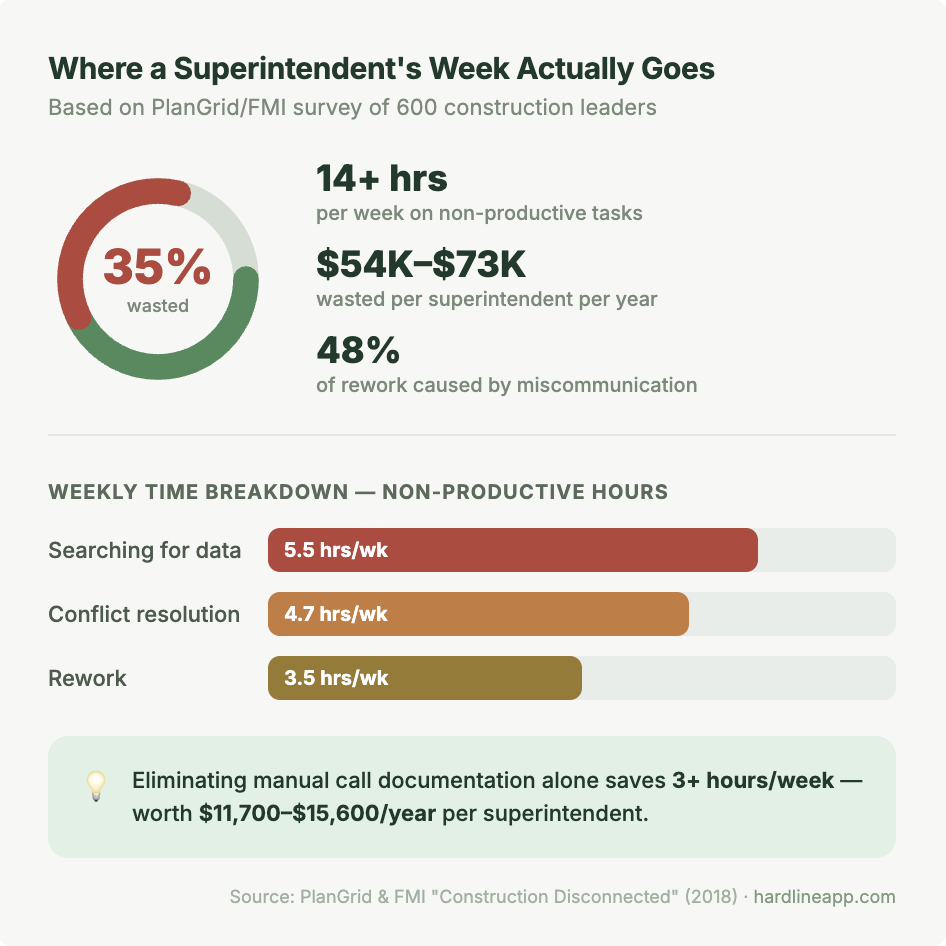
PlanGrid and FMI surveyed nearly 600 construction leaders and found that construction professionals spend 35% of their time on non-productive activities. That's over 14 hours per week — almost two full working days — spent not building.
Here's where those hours go:
- ~5.5 hours/week hunting down project data. Revised plans, the right drawing version, that budget cut sheet someone emailed three weeks ago. You know the drill — scrolling through texts, checking emails, calling someone to ask them to resend something they already sent.
- ~4.7 hours/week on conflict resolution. Which is a nice way of saying "arguing about what somebody said on a phone call last Tuesday." Without documentation, every disagreement becomes a memory contest.
- ~3.5 hours/week dealing with rework. Tearing out and redoing work because the information was wrong, outdated, or never made it to the right person.
That's 13+ hours. Per person. Per week. Gone.
And here's what makes it worse: 48% of that rework is caused by miscommunication and poor project data. Not bad craftsmanship. Not design errors. Just... information that didn't make it from point A to point B.
What a Superintendent's Day Actually Looks Like
Talk to any super and their day follows the same pattern:
5:30–6:30 AM — On site before anyone else. Walking the job, checking what happened overnight, spotting issues before the crews show up.
7:00 AM — Morning huddle. Assigning tasks, reviewing the day's plan, discussing safety, coordinating with foremen and subs.
7:30 AM–12:00 PM — The chaos window. Phone starts buzzing. Questions from subs, calls from the PM, inspector shows up, material delivery is wrong, someone needs a decision on a substitution. You're making 20+ calls before lunch and answering twice that many texts.
12:00–3:00 PM — More field time mixed with schedule updates, coordination calls, and putting out whatever fire started at 11:45.
3:30–5:00 PM — Everyone leaves. Now you're writing daily reports, updating logs, and trying to document everything that happened today... from memory. After a 10-hour day.
Evening — Answering the emails and calls you couldn't get to. Prepping for tomorrow.
One PM tracked her interruptions for a week and found she was booking 8–10 hours of focused work while absorbing almost 2 hours of curveballs daily. Her fix? Stop scheduling more than 6–7 hours of deep work. Because the phone will ring. Always.
The Documentation Trap
Supers are expected to maintain complete documentation of daily operations — work progress, achievements, time-based adjustments, reports for management and clients, legal compliance records. That's not optional. It's the job.
But when does it happen? After a 10-hour day of actually running the site. That's when you're supposed to sit down and write up everything that was discussed, decided, and changed. From memory. While exhausted.
Some supers use 3x5 note cards in the field. Others use OneNote. A few use daily report apps on their tablets. But the fundamental problem is the same: the most critical information on your project — the phone calls, the verbal decisions, the on-the-fly approvals — doesn't get captured when it happens.
It gets captured later. Or not at all.
And then someone asks "who approved that?" and you're digging through your call log trying to remember a conversation from nine days ago.
The Phone Call Black Hole
Superintendents live on the phone. It's where coordination actually happens — schedule changes, material substitutions, scope questions, crew assignments.
But the phone is also a documentation black hole. Every call generates decisions. Almost none of those decisions get formally documented. The super's phone becomes this repository of critical project information that exists nowhere else — not in the PM system, not in the daily log, not in any searchable format.
Field-to-office communication is one of the most common breakdowns in commercial construction. The superintendent knows what happened. The office doesn't. And bridging that gap takes hours of typing, calling, and repeating yourself.
As one super put it: the phone buzzes all day with "Did we get that report?" and "Can you resend the photos?" — repeating the same information multiple ways just so the office can log it.
That's not communication. That's data entry with extra steps.
How to Actually Get Time Back
The usual advice is "prioritize better" and "delegate more." And sure, having a kill list helps. Thinking critical path helps. But you can't delegate the fact that you're the one on the phone making decisions all day — and nobody's capturing any of it.
Where it actually comes from:
Stop documenting after the fact. If information gets captured during the conversation — not hours later from memory — you eliminate the evening documentation session entirely. That's 1-2 hours back every day.
Stop being the information relay. If your calls automatically generate summaries that sync to the PM tool, the office doesn't need to call you asking what happened. That's another 30-60 minutes back.
Stop the "what did we agree on?" cycle. If every verbal commitment is timestamped and documented, you're not spending 4.7 hours per week arguing about what someone said. That shrinks dramatically.
At Hardline, this is what we built. You make your normal calls — same phone, same conversations. Hardline transcribes in real time, pulls out the tasks and decisions, and syncs everything to Procore, Buildertrend, or whatever you use. By the time you hang up with the electrical sub, it's already logged.
The Math
A superintendent's fully loaded cost is roughly $75–100/hour. If they're wasting 14 hours per week on non-productive activities, that's:
- $1,050–$1,400 per week in lost productivity. Per person. - $54,600–$72,800 per year. Per superintendent.
Three supers on your team? That's $160K–$218K per year in time that could be going toward actual project management.
Even getting back 3 hours per week — which is conservative for eliminating manual call documentation — saves $11,700–$15,600 per superintendent per year. And that's before you count the disputes you prevent and the rework you avoid by having better documentation.
The Job Is Building, Not Typing
Superintendents didn't sign up to be data entry clerks. But that's what the job has become — 14 hours a week of chasing information, resolving he-said-she-said conflicts, and writing up calls from memory.
The conversations are already happening. The decisions are already being made. The fix isn't working harder or "managing your time better." It's capturing what's already there — automatically.
That's what Hardline does. You make your calls the same way you always have — Hardline just captures what comes out of them, so you're not spending your evenings catching up on paperwork.
Ready to capture every conversation?
Hardline turns your calls and site conversations into daily logs, RFIs, tasks, and more — automatically.
Book a Demo